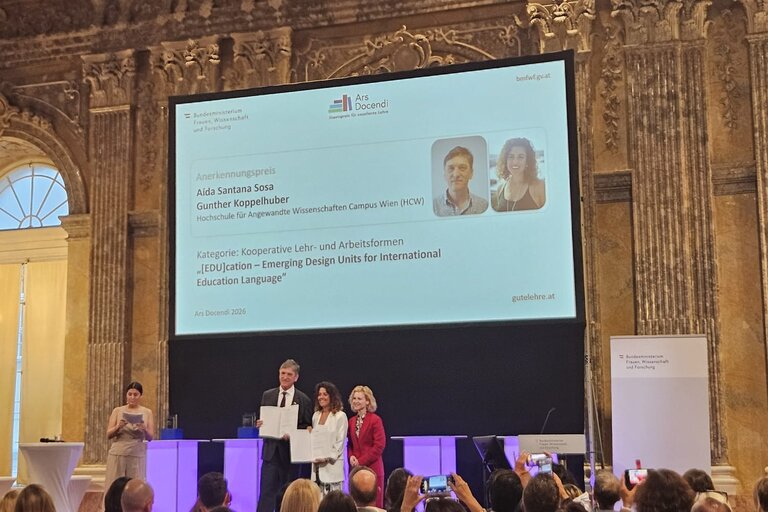
Ars Docendi Recognition Award 2026 for EDUcation
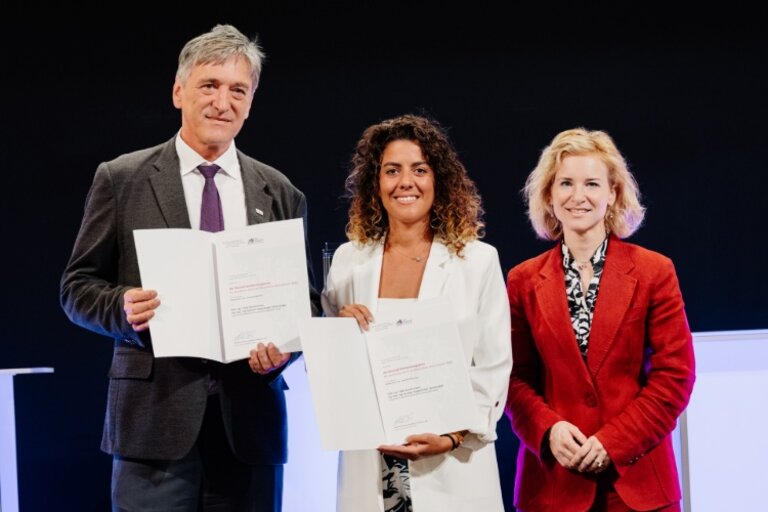
Recognition for International Collaboration in Architectural Education
We are proud to announce that our teaching project, “EDUcation – Emerging Design Units for International Education,” has received the Ars Docendi Recognition Award 2026. A heartfelt thank you to the dedicated team around Aída Santana Sosa and Gunther Koppelhuber, as well as to all participating students whose creativity, commitment, and enthusiasm made this achievement possible.
Hochschule Campus Wien has received the 2026 Ars Docendi Recognition Award from the Federal Ministry of Women, Science and Research in the category “Cooperative Forms of Teaching and Learning”. The award recognises “[EDU]cation – Emerging Design Units for International Education”, a teaching project from the Department of Building and Design. The project combines international collaboration, climate-focused architectural education and innovative teaching methods in a three-stage learning programme.
The teaching team led by Aída Santana Sosa and Gunther Koppelhuber is delighted to receive the award. Evelyn Süss-Stepancik, Vice Rector for Teaching and International Affairs at Hochschule Campus Wien, emphasises: “The Ars Docendi Recognition Award affirms the importance of innovative teaching at Hochschule Campus Wien. The award-winning project from our Department of Building and Design demonstrates how current questions of resource-efficient construction and sustainable urban development can be successfully integrated into higher education.”
Architecture as a response to societal challenges
How should educational buildings be designed to provide healthy spaces that support learning in a changing climate? Students from the Bachelor’s programme in Architecture – Green Building at Hochschule Campus Wien explore this question alongside students from Metropolia University of Applied Sciences in Helsinki and Universitat Politècnica de Catalunya in Barcelona as part of the award-winning “[EDU]cation” project. The focus is on developing climate-resilient concepts for the kindergartens of the future, addressing a real societal challenge: increasing summer overheating in urban environments.
Learning across national borders and climate zones
The project follows a three-stage teaching approach. In the first phase, students work online in international teams, analyse different climate zones and explore strategies for climate-responsive design. Students from three European climate regions benefit from their peers’ knowledge and experience: while Helsinki is shaped by long winters and summer heat protection plays a central role in Barcelona, Vienna sits between these two extremes. The initial online week is followed by an intensive week in Vienna, where students meet in person and develop their designs together. In the final phase, the future architects refine their projects at their home institutions, incorporating technical, economic and regulatory considerations before presenting their results in an international online format.
“The concepts developed show how educational buildings can respond to the challenges of climate change. Measures such as shading, natural ventilation, greening and water-sensitive landscape design demonstrate that architecture is much more than design: it is a responsible response to environmental and societal questions,” say project leaders Aída Santana Sosa and Gunther Koppelhuber.
A lasting commitment
Designed as an Erasmus+ Blended Intensive Programme (BIP), the teaching project was first implemented in 2025 and is scheduled to run until 2028. Following its successful delivery in Vienna, the programme took place in Helsinki in 2026, with a stronger focus on AI-assisted simulation and planning tools. Next year, circular economy and life cycle assessment will be explored in greater depth in Helsinki.